
Introsea Talkshow Series #3: Mining Green Gold from Indonesia

2026-07-13
2026-07-13
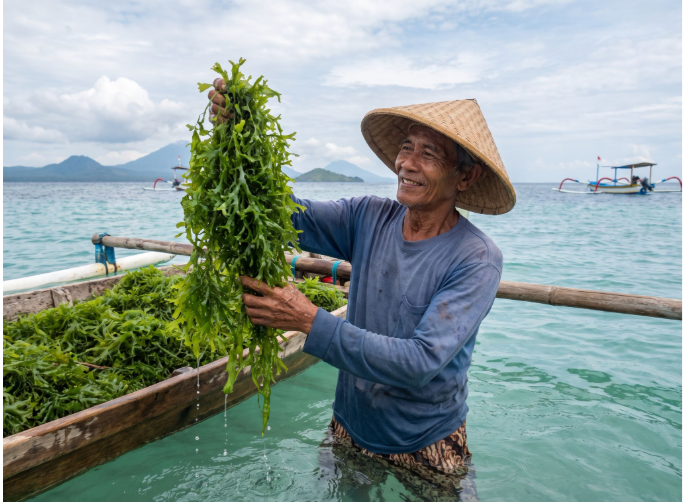
Indonesia is an archipelago with the longest coastline and massive marine potential. One of its leading commodities is seaweed, which is now often dubbed "green gold". Unlike mined gold, seaweed is a renewable resource with extensive added value, ranging from the food, pharmaceutical, and cosmetic industries to agriculture.
This strategic move was discussed in depth during the INTROSEA Talkshow Series #3 titled "Mining Green Gold from the Indonesian Ocean". Unlike previous events, this discussion was held offline by the Indonesian Tropical Seaweed Association (INTROSEA) in collaboration with the Directorate General of PDSPKP of the Ministry of Marine Affairs and Fisheries (KKP) at the Indofisheries Expo 2026 (Hall 6 PIK 2 Tangerang, June 16, 2026) to highlight the potential, challenges, and technological innovations in seaweed downstreaming.
Global Market Opportunities and the Export Irony
Erwin Dipayana, Marketing Director of the Directorate General of PDSPKP (KKP), explained that the global seaweed market trend continues to rise sharply. The main drivers are the global transition towards a healthy lifestyle, food security, and a circular economy.
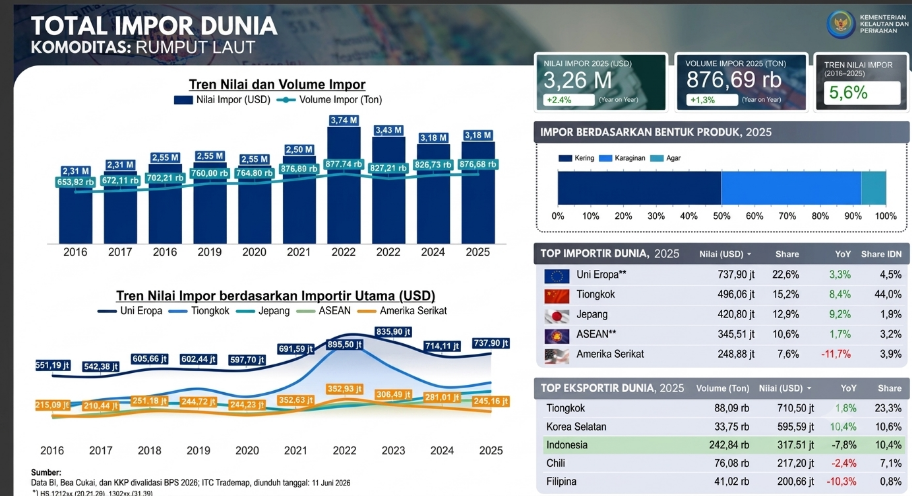
Gambar 1: Data total impor komoditas rumput laut dunia berdasarkan negara importir utama dan kinerja ekspor negara produsen.
Although Indonesia is the world's largest producer of tropical seaweed (especially for the Eucheuma and Gracilaria species), there is a great irony:
🔹About 50% of global seaweed commodities are still traded in the form of raw or dried materials.
🔹Indonesian exports are still dominated by dried seaweed with low economic value, compared to countries like South Korea, which has a smaller production but reaps a higher economic value thanks to processed products (downstreaming).
🔹Indonesia is even recorded as still importing carrageenan and other derivative products from abroad, even though the raw materials originate from the archipelago's waters.
Hidden Potential in Pharmaceuticals and Agriculture
The use of seaweed is no longer just for agar or pudding. Researchers and innovators now see seaweed as a critical material in various crucial sectors.
🔹Pharmaceuticals and Health
Prof. Dr. Masteria Saputra from the National Research and Innovation Agency (BRIN) highlighted the potential of seaweed extracts (such as Ulva and red algae species) for the cosmetic (antioxidant, anti-aging) and medical (antiviral, high iodine) industries. The main challenge currently lies in quality standardization. The seaweed extraction process is highly sensitive to heavy metal contamination. The water quality of the cultivation site is crucial; if heavy metal levels are high, the extract will be rejected by the global pharmaceutical industry.
🔹Agricultural Biostimulants
As an innovative solution presented by Azalea Ayuningtyas, BIRUFINERY develops natural biostimulants from seaweed. Unlike fertilizers, biostimulants act as "vitamins" or hormones for plants to absorb nutrients from the soil more efficiently. Currently, the global biostimulant market is dominated by processed seaweed products from cold climates (Canada, Norway), which are harvested once a year and are expensive. Indonesia, which can harvest tropical seaweed year-round, has a great opportunity to provide more affordable biostimulants. These extracts are claimed to significantly increase the yields of commodities such as palm oil.
Upstream Revolution and Modernization of Seaweed Cultivation
Despite its status as the world's second-largest seaweed producer, Indonesia is currently facing an alarming irony: the national production trend continues to decline every year.
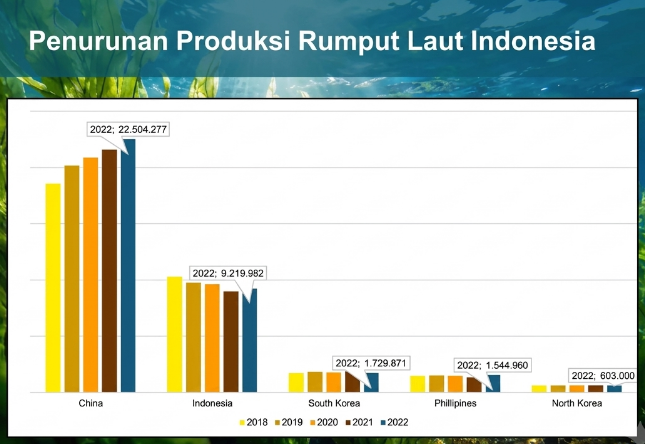
Image 2: A clustered bar chart on a presentation slide displaying the downward trend of Indonesia's annual seaweed production from 2018 to 2022.
Andi J. Sunadin from AQUATEC highlighted this anomaly by comparing Indonesia and China. In fact, Indonesia has a coastline of 95,000 kilometers, three times longer than China's. Ironically, while other countries' production continues to skyrocket, Indonesia's total harvest is continuously shrinking and now only hovers around 40% of China's total production.
Based on the presented data, one contributing factor to this decline in production is the continued use of traditional cultivation methods, which can gradually degrade the land and reduce its long-term productivity. Farmers' reliance on used plastic bottles as floats, which only last for one to two harvests, creates massive piles of waste. These plastic bottles are not entirely carried away by the waves to the open sea but return and accumulate on coastal farms. As a result, productive land space for seaweed cultivation in Indonesia is literally shrinking every year because it is buried by plastic waste from the remnants of the cultivation tools themselves.
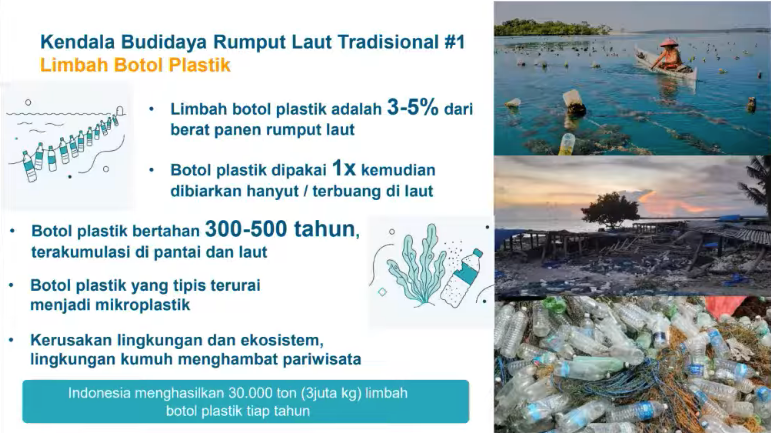
Image 3: An infographic regarding the destructive impact of using single-use plastic bottles as floats in traditional seaweed cultivation.
Besides environmental issues, time inefficiency is also a threat that erodes productivity. The process of manually tying seedlings and assembling/disassembling ropes takes up to 14 days of preparation time per harvest cycle. Because so much productive time evaporates, average farmers are only able to harvest a maximum of 4 times a year. The impact is fatal for the industry chain: the supply of raw materials becomes seasonal and unstable. This supply uncertainty is the main reason why downstream processing industry investors are reluctant to invest in the country.
Ecosystem Synergy
In closing this INTROSEA Webinar Series #3, we can draw one very clear common thread: Indonesian seaweed is "green gold" whose potential is still fast asleep. In this discussion, experts from the government, academics, and startup innovators opened our eyes that seaweed is no longer just a traditional food commodity. Moreover, seaweed is the future for various strategic global industries, ranging from pharmaceutical raw materials and cosmetics to biostimulants capable of revolutionizing our agricultural sector.
However, to truly mine this green gold, there are several crucial steps we must realize together:
🔹Sustainable Upstream Revolution: We must immediately move away from traditional cultivation methods that damage the environment. The use of modern cultivation facility innovations that are free from plastic bottle waste will not only save our oceans from microplastics but also multiply productivity and maintain harvest consistency.
🔹Standardization and Downstreaming: The irony of being the world's number two producer that still imports derivative products must be ended immediately. An investment push in research and technology is needed to produce high-value extracts (like carrageenan and agar) that meet global industry standards, especially regarding safety from heavy metal contamination.
🔹Building an Integrated Ecosystem: The challenge of downstreaming cannot be solved if the upstream supply is inconsistent, and upstream farmers will not innovate if the downstream market has not been established. This is an ecosystem problem.
Ultimately, the glory of the Indonesian seaweed industry cannot be built overnight, and certainly cannot be achieved alone. Real collaboration and synergy are needed between cultivators, the government (regulators), academics (researchers), investors, and industry players.
Source: Talkshow Series #3 materials from Introsea, June 16, 2026.
Contact Person : Secretary General of Introsea, Bapak Didit Adiputra
Other Article
Introsea Webinar Series #5 : From Biomass to Bioeconomy Unlocking Higher Value from Indonesia’s Seaweed
2026-09-17
Introsea Webinar Series #4 : Strengthening the Upstream to Unlock Sustainable Seaweed Innovation
2026-08-13
Introsea Webinar Series #2 : Transforming Indonesia’s Seaweed Industry for Food Self-Sufficiency and Global Competitiveness
2026-06-12